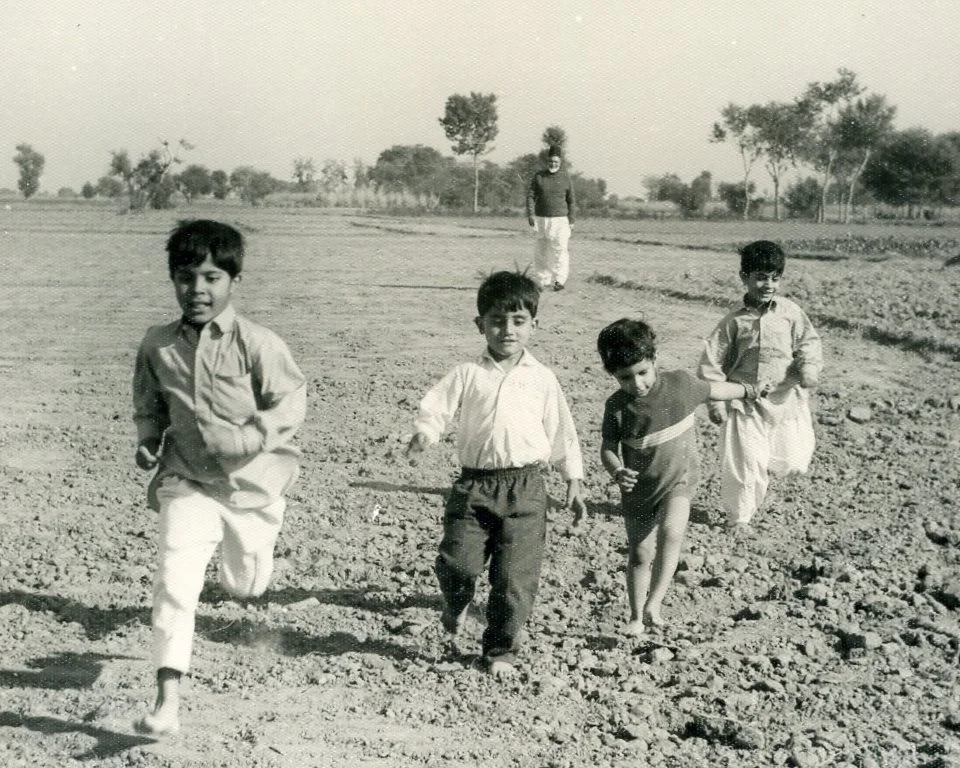
My father tells me stories of growing up in the Punjab in the 1940s. They are typical teenage stories in the sense that they feature a gaggle of early- mid- late- teen boys wandering around, engaging in risky and unsanctioned behavior, and immediately racing home at the first hint of trouble. Narratively speaking, they are coming-of-age stories, familiar and universal. The only difference is that the events he recollects take place in a far-off, dusty place almost a century ago. And there is no mention of women. Not just in that there is no reference to a girl who was a peer, friend, or love interest, because, given the culture and time, that would be surprising. But in any sense. My father had a mother and a stepmother and sisters. Yet, there is simply no reference to women. It is a blank space.
I ask my 90-year old father, “What were your sisters doing while you were gallivanting?” “Where did your mother get groceries and food to cook?” “Who helped her?” “Who was taking care of the little ones?” My father, a lawyer, an intellectual, a man who put my mother on a pedestal and raised me, his only daughter, to believe in no limits, says, almost quizzically, “I have no idea.”
Women throughout history have gone about the daily business of running the family enterprise: nurturing, earning, organizing, bearing and raising children, taking care of the elderly, and generally supporting others, all while remaining mostly unseen. Within their family, they may be celebrated as heroes, but writ large, they have not been written into history. And yet each of us is who we are as a function of the home in which we were raised. I am fascinated by women and the family unit they were born into and the kind of community they adopt as adults. I cannot help but wonder about female characters and whether they are willing or unwilling participants in the larger system in which they find themselves. What is the nature of the agency in their life decisions? How do they react when life does not go according to plan? What is the inflection of a mother’s voice and how does it affect those around her? What do women dream of in the privacy of their minds when the day is done? While much of history concerns itself with the memorialization and celebration of the achievement of men, I am more interested in the inner lives of women and the dynamics in which they survive and thrive.
I write about extraordinary people living ordinary lives. I write about the unseen lives of women. I write to fill in the blank spaces.